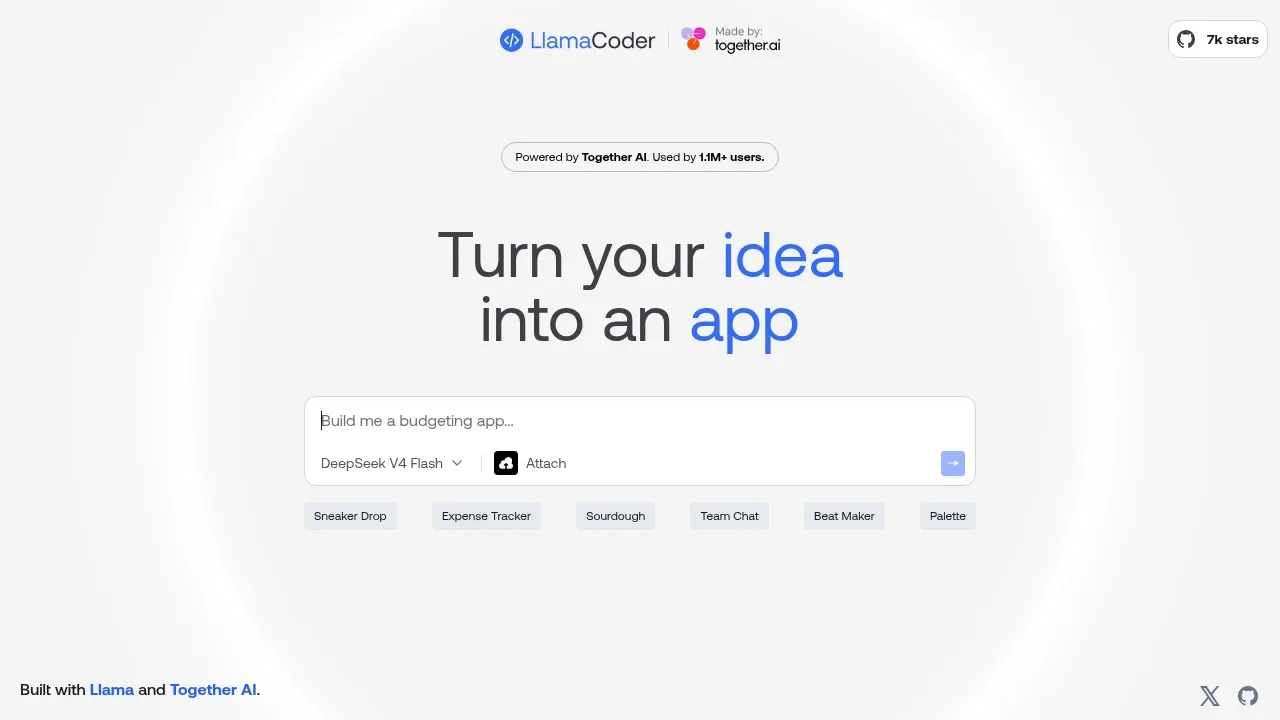
LlamaCoder generates small apps from a single prompt and previews them in your browser. It's an open-source alternative to Claude Artifacts for people who want to turn an idea into an app, with a MIT license that lets them run and modify the code themselves.
You can use the hosted website or run your own copy locally. That distinction matters for privacy and hardware: the app can run on your machine, but Together AI handles model inference in the cloud. Prompts go to that service, so a local deployment still needs an internet connection and a Together AI API key. It isn't an offline local LLM runner.
The hosted interface offers DeepSeek V4 Flash. The repository also describes generation with Meta's Llama 3.1 405B through Together AI. App previews run in a sandboxed browser iframe, so you can see the generated result alongside the code generation experience.
For developers choosing a project to adapt, the codebase uses TypeScript, Next.js and Tailwind. Its preview renderer uses esbuild-wasm and esm.sh to render generated apps in the browser. A self-hosted copy also requires a PostgreSQL database connection, and screenshot uploads use S3 storage.
Claim this page with an email at llamacoder.together.ai. LlamaCoder gets the verified badge, and you can upgrade the listing to be featured on localhosted. Proud to be listed? Put our badge on your site.
Want more people to find LlamaCoder?Promote it
Something wrong or outdated on this page?
19.9KUpdated 8 months agoMIT
macOS · Windows · Linux · Docker · Web#Code execution#Git integration#LM Studio integration
Bolt.diy is a self-hosted AI coding assistant for people building full-stack Node.js web apps who want to choose their own model provider. It's a fork of Bolt.new, with a browser workspace and an Electron desktop app for macOS, Windows, and Linux. You can also run it through Docker.
26.8KUpdated 2 months agoApache-2.0
Web#Code execution#Git integration#Multimodal input
544Updated 14 hours agoMIT
macOS · iOS · Web#Code execution#Distributed execution#Hugging Face integration
73.1KUpdated 1 day ago
iOS · Android · Docker · Web#Multi-user access
AFFiNE is a local-first knowledge workspace for individuals and teams who want documents and visual planning in the same place. It combines a block editor, an edgeless whiteboard and databases, making it an alternative to Notion and Miro for team wikis, project plans and connected notes.
22.6KUpdated 3 months agoApache-2.0
macOS · Docker · Web#Ollama integration#OpenAI-compatible API
55.1KUpdated 2 years agoMIT
Windows · Docker#Code execution#Multimodal input
Onlook is a visual code editor for designers who want to work directly on a website rather than hand off a separate mockup. It uses the actual app code as the design source, so visual edits change the product itself. The Apache 2.0 project can run locally or be self-hosted; Onlook also offers a hosted cloud product.
Pooled runs a single open model across browser tabs on laptops, desktops and phones, combining their memory when the model won't fit on one device. It's for people who want local AI chat or a coding assistant using hardware they already have. It's open source under the MIT license and requires no account or per-device installation.
OpenUI is a self-hosted AI UI builder for developers prototyping web interfaces with models they choose. It turns plain-language descriptions into rendered interfaces, with a live preview and follow-up requests for changes. You can run the app locally through Docker or Python and use it in your browser.
gpt-engineer is a locally run coding assistant for developers who want to experiment with AI code generation and build their own agents. It can create software from plain-language descriptions or make requested changes to an existing codebase. The project is archived and no longer maintained. Its Python code is open source under the MIT license.