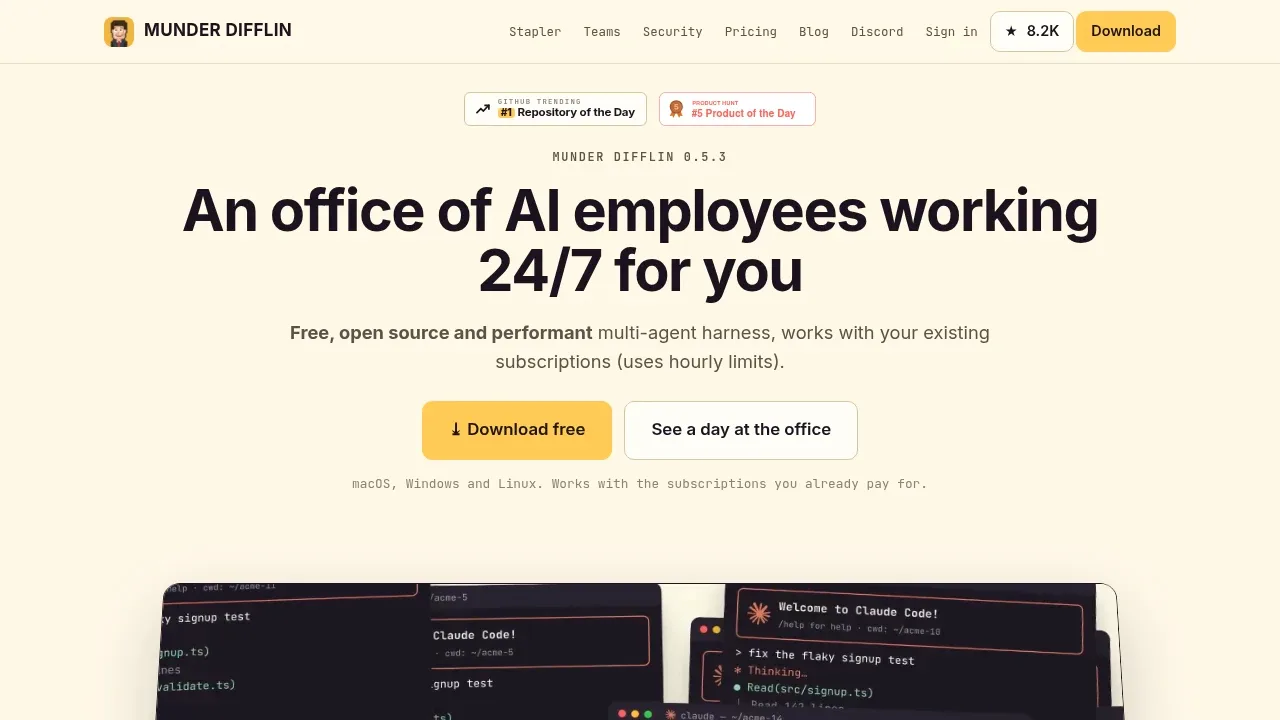
Munder Difflin is a desktop app for developers who want several coding agents to work together on their own machine. It runs on macOS, Windows and Linux, with an orchestrator that divides requests into tasks, assigns agents and brings questions back to you in one place. The project is free and open source under the MIT license, with paid offerings alongside it.
It works with Claude Code, Codex, Gemini CLI, GitHub Copilot and Cursor, among other terminal coding assistants. These remain real CLI agents using your existing subscriptions or API keys. You can also connect local models through Ollama, LM Studio or vLLM, so the desktop workspace doesn't limit you to cloud providers.
Agents share a task board and exchange messages through individual inboxes. Their memory persists across sessions, and you can search the office's history to find what agents learned or who handled a task. Separate projects get their own agents, boards and memories, and can run side by side.
The pixel office view shows agents as characters at desks, with live terminals you can inspect and respond to. Autonomy controls send spending, scope changes and destructive operations back for approval. A circuit breaker stops runaway work, while crashed agents restart in their working folder.
The harness and its memory run locally. GitHub, Linear, Telegram and webhooks can trigger agents. Messages between agents on different machines use encryption that prevents the relay from reading their contents. Agents stop when the machine stops.
Claim this page with an email at munderdiffl.in. Munder Difflin gets the verified badge, and you can upgrade the listing to be featured on localhosted. Proud to be listed? Put our badge on your site.
Want more people to find Munder Difflin?Promote it
Something wrong or outdated on this page?
137Updated 18 hours ago
macOS · Windows · Linux · Docker · Web#Agent Skills#Human approval#Knowledge graphs
Project Orchestrator is a self-hosted coordination tool for developers working with multiple AI coding agents. It keeps code knowledge, development plans, and architectural decisions in a shared store so agents can reuse context across tasks and projects. It runs on macOS, Windows, and Linux, with desktop apps and Docker deployment available.
1.5KUpdated 24 hours agoMIT
macOS · Windows#Agent Skills#MCP#Ollama integration
162Updated 2 months ago
#Code execution#MCP#Multi-agent workflows
Forge Orchestrator coordinates Claude Code, Codex CLI, and Gemini CLI when they work on the same repository. It's for developers who use multiple AI coding assistants and need them to share decisions, respect file ownership, and follow the same specification.
4.4KUpdated 1 week agoApache-2.0
Web#Agent Skills#Human approval#MCP
MS Agent is an open-source Python framework for developers building AI agents that carry out complex tasks over multiple sessions. Its browser workspace works with local projects, while terminal interfaces and a Python SDK share the same agent logic. It uses the Apache 2.0 license and supports OpenAI-compatible APIs, Anthropic and ModelScope.
1.2KUpdated 4 weeks agoMIT
#Agent Skills#Code execution#Git integration
1.5KUpdated 2 days agoMIT
Docker · Web#Code execution#Context compression#LLM tracing
Minutes is a free, MIT-licensed open source app that turns meetings, calls, voice memos, and dictation into local Markdown files. It runs on Apple Silicon Macs and Windows, for people who want to read their own notes or let an AI assistant search their conversation history.
Pi Subagents adds specialized AI agents to pi for developers who want to split coding work across separate sessions. Each agent can have its own model, prompt and tool permissions. The extension runs within pi and is open source under the MIT license.
Exo Agent Framework is a self-hosted framework for developers building long-running AI agents that can revise their own code, tools and prompts. Its exoharness foundation keeps agent history and resources separate from the logic that decides what the agent does next. The project is open source under the MIT license.