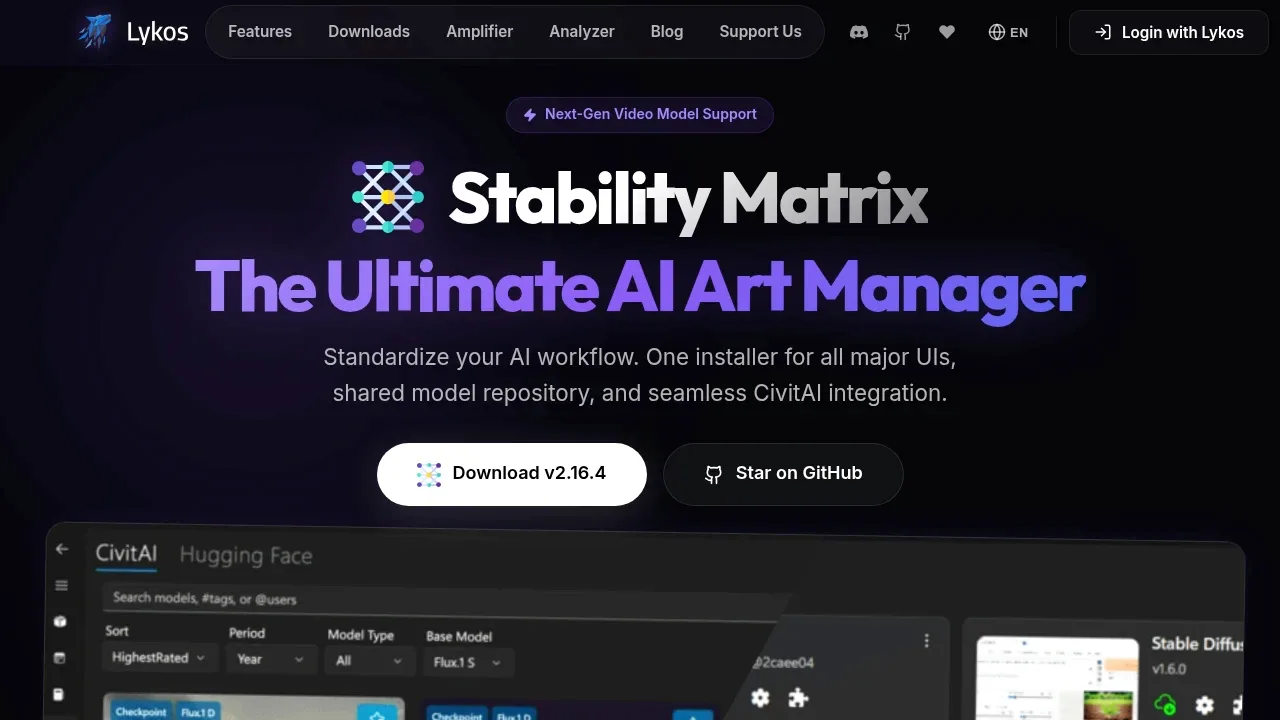
Stability Matrix is an open source desktop app for people who use more than one Stable Diffusion interface. It manages local installations of ComfyUI, Automatic1111, Fooocus, Forge, and InvokeAI, so you can try different workflows without maintaining a separate model collection for each one. It runs on Windows, macOS, and Linux under the AGPL-3.0 license.
Its shared model directory is the main reason to choose it. Installed interfaces can draw from the same checkpoints, LoRAs, and embeddings, which cuts duplicate files when you move between UIs. The app also manages updates for those interfaces and their extensions. Your setup is portable: the app and its resources can move together in a folder to another drive or computer.
You can browse and download models from CivitAI within the app, or import local files. The model manager can fetch previews and CivitAI metadata for models you already have. Hugging Face is another source for model imports. Those online model sources need an internet connection; the installed Web UIs and shared model files are kept locally.
Stability Matrix also includes Inference, its own image generation interface. It has tabbed workspaces saved as project files, adjustable panels, and a gallery that can reload a previous image's settings. Generated images can carry project information alongside ComfyUI node data and Automatic1111-compatible metadata, making it easier to return to a setup after generating an image.
Claim this page with an email at lykos.ai. Stability Matrix gets the verified badge, and you can upgrade the listing to be featured on localhosted. Proud to be listed? Put our badge on your site.
Want more people to find Stability Matrix?Promote it
Something wrong or outdated on this page?
10.5KUpdated 3 weeks ago
macOS · Windows · Linux · Web#Batch processing#ControlNet#Image-to-image
Easy Diffusion runs Stable Diffusion on your own computer through a browser interface. It's for people who want to generate and edit images locally without assembling the software components themselves. The free distribution bundles the required software and works on Windows, Linux and macOS.
135.6KUpdated 48 minutes agoGPL-3.0
macOS · Windows · Linux · Web#ControlNet#Inpainting#LoRA
53.2KUpdated 1 year agoGPL-3.0
macOS · Windows · Linux · Docker · Web#ControlNet#Image-to-image#Inpainting
28.3KUpdated 3 days agoApache-2.0
macOS · Windows · Linux · Docker · Web#Batch processing#ControlNet#GGUF
10.7KUpdated 3 days agoGPL-3.0
macOS · Windows · Linux#ControlNet#Image-to-image#Inpainting
5.8KUpdated 1 day agoApache-2.0
macOS · Windows · Linux · iOS · Android · Docker#GGUF#Hugging Face integration#llama.cpp backend
ComfyUI is a local visual AI workspace for artists and technical teams who want to control how images, video, audio, 3D models and text are made. Its node canvas shows each model and processing step, so users can build and adjust workflows without writing code. It runs on your hardware.
Fooocus is a free, open-source AI image generator for people who want to create images on their own computer without spending much time tuning settings. It uses Stable Diffusion XL and automatically expands prompts with a local GPT-2 engine. Generation works offline once the required models are downloaded, so prompts and images can stay on your machine.
InvokeAI is a free, open-source image generator for artists and production teams who want to create and edit images on their own hardware. Its locally hosted web interface brings image generation, canvas editing and workflow tools into one application. With local models, prompts and artwork stay on the machine you control.
Krita AI Diffusion brings image generation into Krita for artists who want to paint and edit in the same workspace. The open source plugin is licensed under GNU GPL v3.0 and can run generation for free on your own hardware through ComfyUI. Interstice.cloud offers a separate online generation service for people without a suitable GPU.
Lemonade is an open source local AI server for people who want to use models on their own hardware or connect them to apps and agents. It handles chat, coding, image generation, speech, transcription, and embeddings. A built-in interface lets you use those capabilities directly, while its server makes them available to other software.