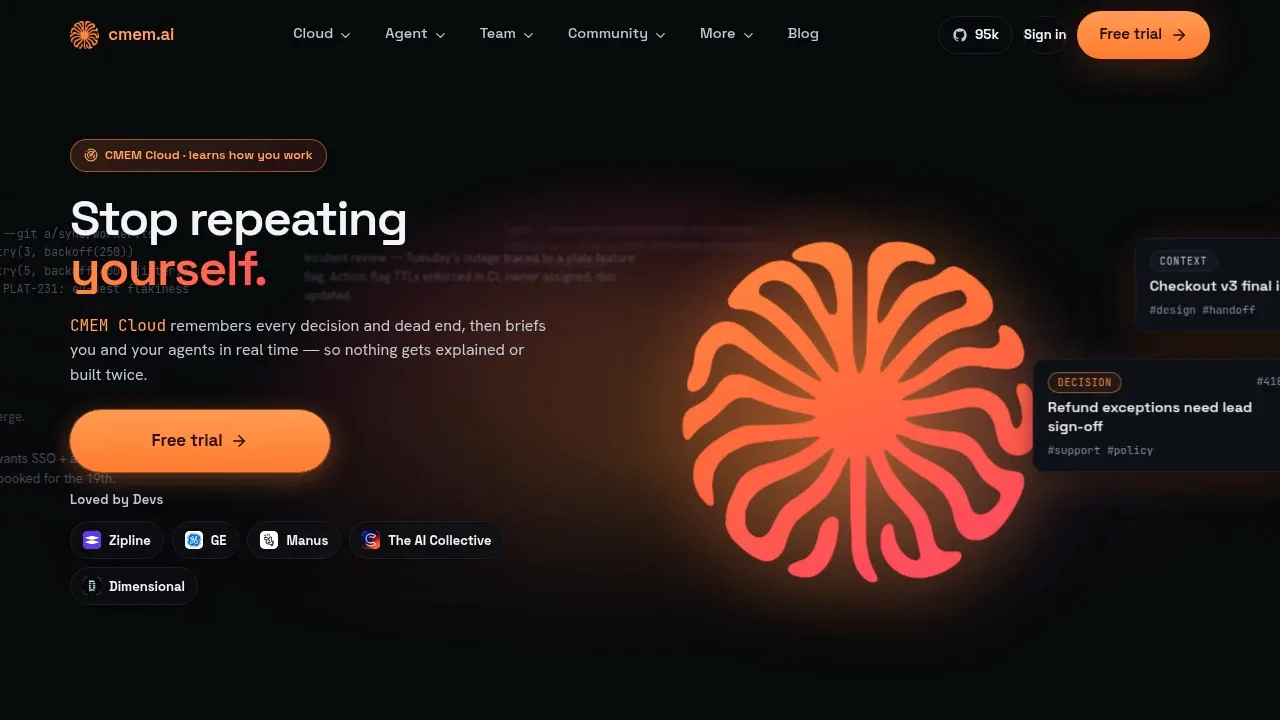
Claude Mem gives coding assistants persistent project memory, so developers don't have to explain earlier decisions each time a session starts. It records agent activity, turns it into structured observations and summaries, and brings relevant context into later sessions. The free, open source engine runs on your machine under the Apache 2.0 license and doesn't require an account.
Memory covers fixes, failed approaches and the reasoning behind decisions. Semantic search finds observations by meaning, while keyword search and filters narrow results by project, date or observation type. A timeline adds the surrounding history, helping an agent understand what changed and what a decision replaced. Retrieval starts with compact results and fetches fuller details when needed, reducing the amount of history added to the agent's context.
The engine stores sessions, observations and summaries in a local SQLite database, and semantic recall runs locally. It works with Claude Code, Cursor and other MCP clients; integrations also include Codex CLI, OpenClaw and Gemini CLI. A local web viewer lets developers inspect and search the stored history, and Windows setup is supported.
CMEM Cloud is a separate paid service that mirrors the observations database to hosted storage. Its offline-first sync lets agents on different machines access shared memory through a private MCP link. The cloud offering also includes a live memory feed on your phone.
Claim this page with an email at claude-mem.ai. Claude Mem gets the verified badge, and you can upgrade the listing to be featured on localhosted. Proud to be listed? Put our badge on your site.
Want more people to find Claude Mem?Promote it
Something wrong or outdated on this page?
29.1KUpdated 8 hours agoApache-2.0
macOS · Windows · Linux · Docker · Web#Agent Skills#Git integration#Hybrid search
agentmemory is a self-hosted memory server for developers who want their coding agents to retain project decisions, past fixes and preferences across sessions. It captures activity through agent hooks and retrieves relevant context for later work. Multiple agents can share the same memory, so switching between Claude Code, Cursor and Codex CLI doesn't mean starting with an empty history.
8.7KUpdated 19 hours agoMIT
macOS · Windows · Linux · Docker · Web#Git integration#Hybrid search#Knowledge graphs
45.6KUpdated 2 hours agoMIT
macOS · Windows · Linux · Web#Git integration#Knowledge graphs#MCP
Codebase Memory MCP gives AI coding agents a persistent map of a repository's structure, so they can answer questions about dependencies and call chains without repeatedly reading whole files. It's for developers using Claude Code, Codex CLI, Cursor or other MCP-compatible clients who want their agents to spend less context on code exploration.
39.1KUpdated 1 day agoAGPL-3.0
macOS · Windows · Linux · Docker · Web#Agent Skills#Knowledge graphs#MCP
137Updated 14 hours ago
macOS · Windows · Linux · Docker · Web#Agent Skills#Human approval#Knowledge graphs
4.4KUpdated 24 hours agoMIT
macOS · Windows · Linux · Web · JetBrains#Agent Client Protocol#Code execution#Git integration
ai-memory keeps project knowledge on a server you control so developers can switch coding assistants or machines without losing context. It connects Claude Code, Codex, Cursor, Gemini CLI and OpenCode to shared memory, including unfinished work, failed approaches and open questions.
OpenViking is a self-hosted context database for developers who want agents to retain knowledge across sessions and inspect what they remember. It puts documents, memories and skills in a browsable directory structure, with editable content instead of an opaque collection of embeddings.
Project Orchestrator is a self-hosted coordination tool for developers working with multiple AI coding agents. It keeps code knowledge, development plans, and architectural decisions in a shared store so agents can reuse context across tasks and projects. It runs on macOS, Windows, and Linux, with desktop apps and Docker deployment available.
gptme is a self-hosted AI agent that works directly in your terminal, with access to your files and installed tools. It's for developers who want a coding assistant in their own environment, and people who want an agent for data analysis or other knowledge work. The software is free under the MIT license and doesn't require a gptme account.