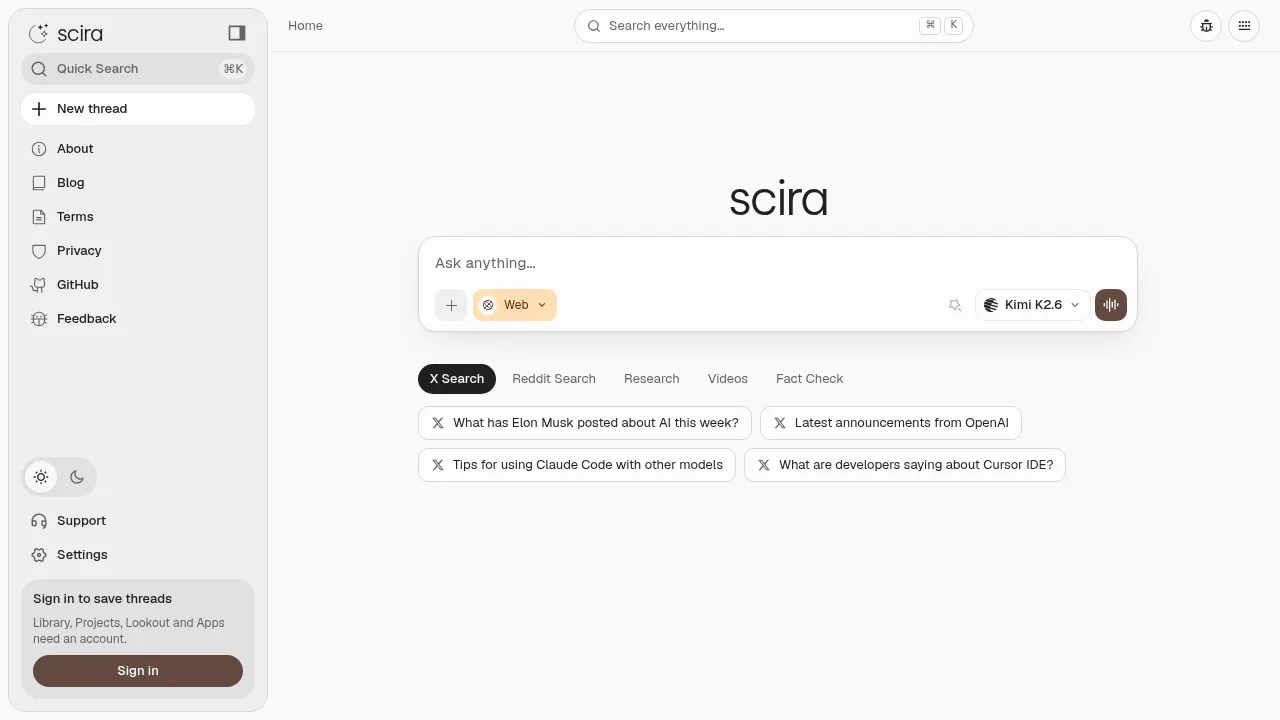
Scira is an AI search engine for people who want answers backed by sources and control over the application they use for research. It has a hosted website, and you can self-host the open-source application under AGPL-3.0. Its live search relies on internet access and external services; self-hosting doesn't make that research offline.
For complex questions, Scira breaks the research into smaller tasks, searches live sources, and cross-checks the evidence. Answers include clickable inline citations so you can inspect the material behind a claim. You can ask about a topic, provide a URL, or upload documents for questions about their contents. It supports PDF, CSV, DOCX, and Excel files.
Search modes cover academic papers, Reddit discussions, X posts, and GitHub repositories. YouTube search includes transcripts and video summaries, while deeper research combines multiple sources and analysis. Financial research includes stock charts, CoinGecko cryptocurrency data, and prediction markets from Polymarket and Kalshi. A separate chat mode lets you talk to a model without searching.
Scira supports model families including OpenAI GPT, Anthropic Claude, Google Gemini, Qwen, and DeepSeek; the hosted interface also offers Kimi K2.6. Self-hosters can bring their own models and connect custom tools. Recurring research agents called Lookouts monitor topics, track changes, and send email updates. A Python code interpreter runs in a Daytona sandbox and can generate charts.
Claim this page with an email at scira.ai. Scira gets the verified badge, and you can upgrade the listing to be featured on localhosted. Proud to be listed? Put our badge on your site.
Want more people to find Scira?Promote it
Something wrong or outdated on this page?
37.5KUpdated 2 months agoAGPL-3.0
Web#RAG#Semantic search#Web search
Khoj is an AI assistant for people who want to ask questions across their own files, research the web, and give recurring work to agents. You can self-host it on your computer or server, or use Khoj's cloud app. It's open source under the GNU AGPL v3.0 license.
32.3KUpdated 24 hours ago
Docker · Web · Browser Extension#MCP#Multi-user access#Ollama integration
10.5KUpdated 7 months agoApache-2.0
macOS · Windows · Linux · Android · Web#Code execution#MCP#Multimodal input
41.2KUpdated 1 day agoAGPL-3.0
macOS · Docker · Web#Code execution#Hybrid search#LM Studio integration
18.3KUpdated 24 hours agoMIT
macOS · Windows · Linux · Docker · Web#Human approval#Hybrid search#llama.cpp backend
12KUpdated 12 months agoApache-2.0
macOS · Windows · Linux · Docker · Web#Code execution#llama.cpp backend#Multi-user access
Onyx is an AI search and chat platform for teams whose information is spread across workplace apps. It indexes company knowledge so employees can ask questions across sources and get answers grounded in relevant documents. Teams can deploy it in their own cloud or on bare metal, including an air-gapped environment.
aichat brings Ollama and cloud AI services into the same terminal interface for developers and people who work at the command line. It runs locally on macOS, Linux and Windows, with Android support through Termux. Model processing happens through the backend you choose: Ollama supports local models, while providers such as OpenAI, Claude and Gemini process requests in the cloud.
AstrBot brings AI assistants into messaging apps such as Telegram, Discord, Slack, QQ and WeCom. It's an open source platform under AGPL-3.0 for people building personal companions, customer support bots or team automation. You can run it on your own computer or server, including through Docker, or use its desktop app for browser-style chat.
DocsGPT is an MIT-licensed, open-source platform for teams that want AI search, assistants and agents over their own documents. It can run on your servers with local models, including fully air-gapped deployments where documents and questions stay inside your network. Answers include the source title and page number so readers can check the evidence.
h2oGPT is a self-hosted ChatGPT alternative for people who want to chat with local models and ask questions about their own documents. The project is archived and no longer maintained. It's open source under Apache 2.0, with support for Linux, macOS, Windows and Docker.