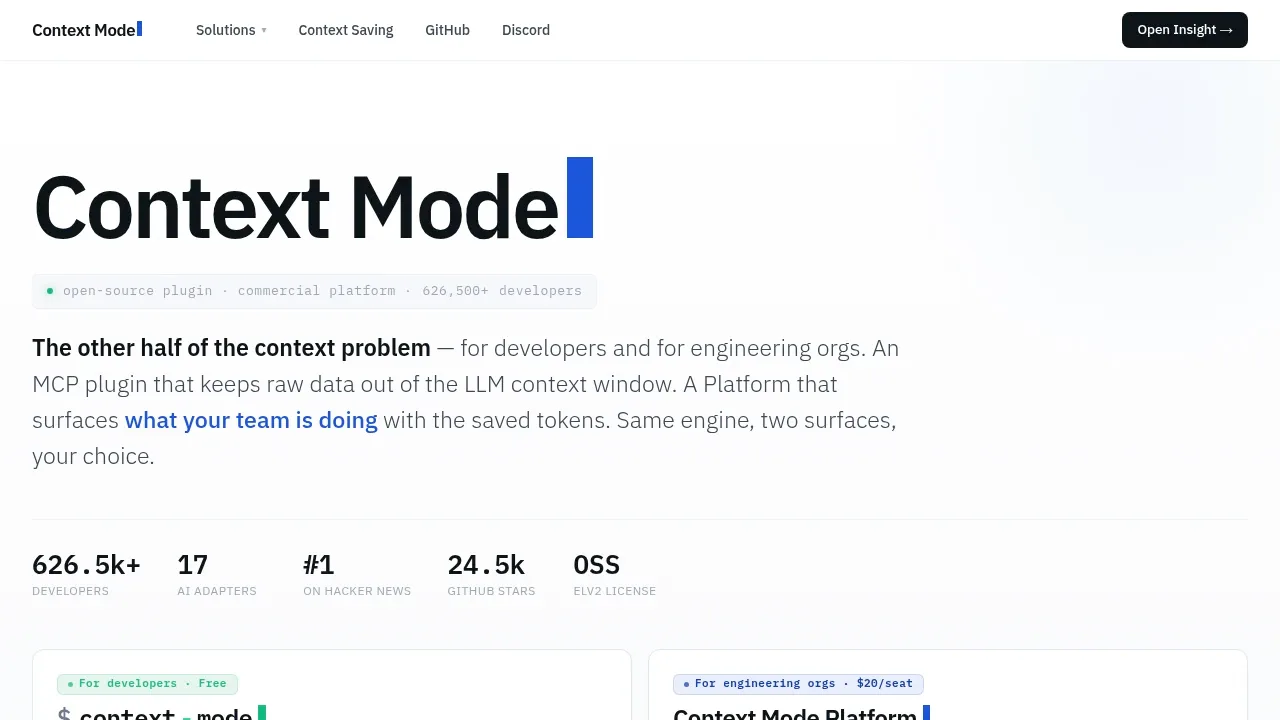
Context Mode is a local MCP plugin for developers whose AI coding agents fill their context windows with file reads, logs, search results and other tool output. It keeps large responses in a searchable store on your machine so the agent can retrieve relevant passages instead of carrying the full output through the conversation.
The free plugin runs entirely on your machine, without a network connection, account or telemetry. It's source-available under Elastic License 2.0. It works with Claude Code, Cursor, Codex CLI, Gemini CLI and GitHub Copilot, as well as OpenCode and Zed. Capabilities differ by integration: supported hooks can enforce tool routing, while other integrations rely on instructions to the agent.
Local SQLite full-text search gives the agent access to stored material, including web pages, API responses and browser snapshots. The sandbox also applies configured command permissions, and file execution refuses paths that escape the project root. These controls extend existing restrictions to work the agent performs through the plugin.
A separate paid, hosted Platform serves engineering teams. Its Insight product uses workflow events to identify retry waste, error spikes, rework and blockers across individual, team and organization views. Forwarding is opt-in: tool names, file paths, error counts and other structural metadata go to the organization's workspace. Source code, prompt content and file content stay on developers' machines.
Claim this page with an email at context-mode.com. Context Mode gets the verified badge, and you can upgrade the listing to be featured on localhosted. Proud to be listed? Put our badge on your site.
Want more people to find Context Mode?Promote it
Something wrong or outdated on this page?
42.5KUpdated 9 hours agoApache-2.0
Docker · Web#Guardrails#Human approval#LLM tracing
Agno is a Python framework and runtime for developers building customer-facing or internal AI agents. You can run its agent platform locally with Docker, on your own servers or in your cloud. The open-source framework uses the Apache 2.0 license, and the platform keeps sessions, memory, knowledge and traces in your database.
1.2KUpdated 1 day agoApache-2.0
Linux · Docker#Code execution#Git integration#Guardrails
Coding Tools MCP gives AI chat apps and agents access to a codebase on your own machine through the Model Context Protocol (MCP). It's for developers who want their existing client to read files, edit code and run tests, with access confined to a chosen workspace. The Python server is open source under Apache 2.0 and can also run in Docker.
27.6KUpdated 1 day agoMIT
macOS · Windows · Linux#Code execution#MCP#Tool calling
1.6KUpdated 1 month agoGPL-3.0
macOS#Code execution#Guardrails#MCP
9.5KUpdated 2 days agoApache-2.0
Docker · Web#Guardrails#MCP#Tool calling
1.1KUpdated 16 hours agoMIT
Docker#Code execution#MCP#Tool calling
Cua gives AI agents access to computers they can inspect and operate, with tools for desktop automation, local virtual machines, and hosted fleets. It's for developers building agents that work across native apps and browsers, or evaluating how well those agents complete computer tasks. You bring the agent and model.
Dory brings Docker, Kubernetes and Linux virtual machines into a native macOS app, with dedicated sandboxes for coding agents. It's for developers who want container workflows and separate Linux environments on an Apple Silicon Mac. It runs on macOS Sonoma or later and is open source under GPL-3.0.
Higress is a self-hosted AI gateway for developers and teams managing model APIs and the tools their AI agents call. It puts LLM traffic and MCP servers behind a shared entry point, with authentication, traffic controls and monitoring. The open-source edition uses the Apache 2.0 license and runs locally in Docker without registration. Alibaba Cloud also offers a fully managed gateway.
LLM Sandbox is a Python library for developers building AI agents and applications that need to execute model-generated code. It runs that code in isolated containers on infrastructure you control, with Docker and Podman backends or Kubernetes for cluster deployments. The project is open source under the MIT license.