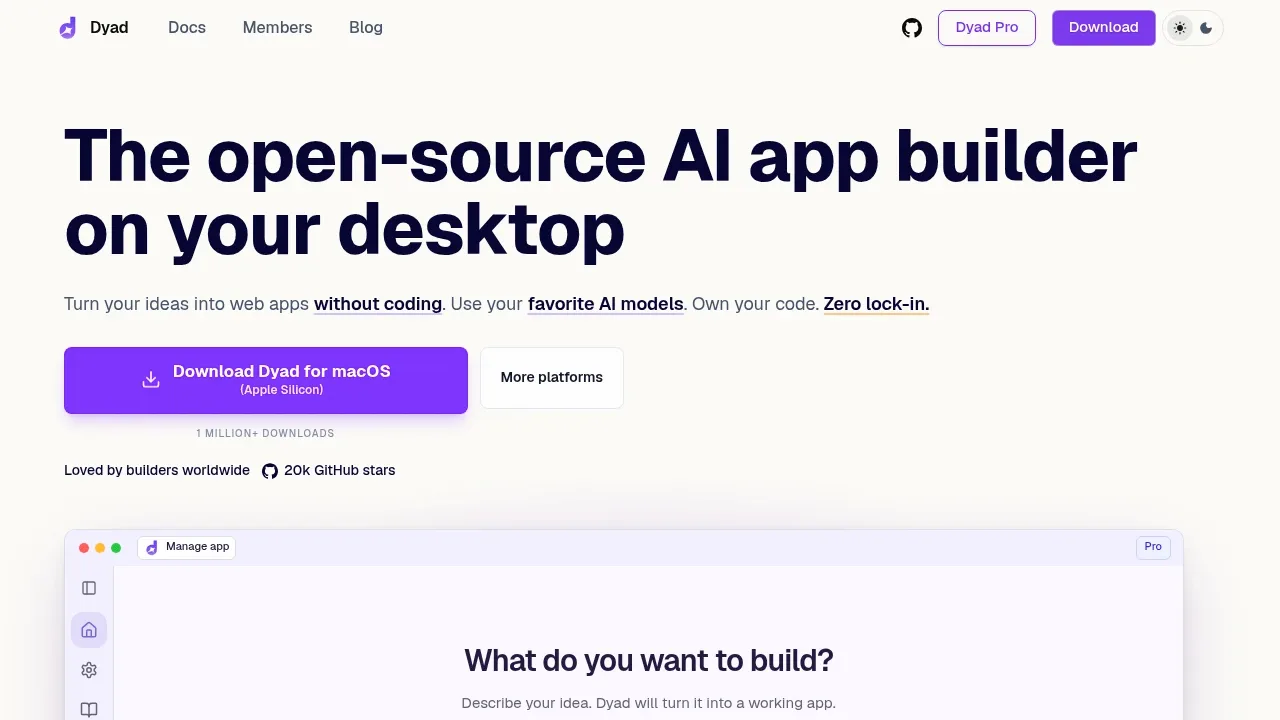
Dyad turns a written idea into a working web app on your desktop. It's for people who want to build without starting from code, as well as developers who want to keep control of the result. The app requires no sign-up and runs on macOS and Windows. Your project files stay on your machine.
You can use local models through Ollama or LM Studio and work offline. Dyad also supports OpenAI, Anthropic, and Google models, which use their respective cloud services. You can bring your own API keys and switch model providers as a project changes.
Dyad can build full-stack apps with database and authentication support through Supabase or Neon. Its visual tools let you adjust an app while retaining access to the code. You can import an existing repository, edit files in VS Code, and export runnable Next.js code. A built-in security scan checks for issues such as injection risks and authentication mistakes.
For projects that need outside tools, Dyad supports MCP servers, including Chrome DevTools, web browsing, and custom APIs. It can publish through GitHub and Vercel or another cloud provider.
Claim this page with an email at dyad.sh. Dyad gets the verified badge, and you can upgrade the listing to be featured on localhosted. Proud to be listed? Put our badge on your site.
Want more people to find Dyad?Promote it
Something wrong or outdated on this page?
31.3KUpdated 3 weeks agoMIT
macOS · Windows · Linux#Ollama integration#OpenAI-compatible API#Streaming inference
Meetily is a local AI meeting assistant for people who want meeting notes while keeping recordings on their own device. It captures calls from Zoom, Google Meet, Microsoft Teams and other meeting software without placing a bot in the meeting. You can watch the transcript appear during the call, then generate a summary.
39.6KUpdated 3 weeks agoMIT
Docker · Web#LM Studio integration#Ollama integration#OpenAI-compatible API
19.9KUpdated 8 months agoMIT
macOS · Windows · Linux · Docker · Web#Code execution#Git integration#LM Studio integration
155.4KUpdated 1 day agoMIT
macOS · Windows · Docker · Web#LLM tracing#MCP#Multi-agent workflows
4.7KUpdated 1 month agoMIT
macOS · Windows · Linux#Visual workflows
Rivet is a desktop visual programming environment for developers building AI agents and applications with complex LLM workflows. Its editor runs on macOS, Windows and Linux, and its TypeScript library executes the resulting graphs inside your own application. The project uses the MIT license.
70.7KUpdated 8 months agoMIT
Windows · Docker#Code execution#Multi-agent workflows#Ollama integration
Open Notebook is a self-hosted alternative to Google's NotebookLM for researchers, students, and professionals who want AI help with their own research materials. It runs locally or on your server through Docker and is open source under the MIT license. You choose which content the AI can access and which provider processes it.
Bolt.diy is a self-hosted AI coding assistant for people building full-stack Node.js web apps who want to choose their own model provider. It's a fork of Bolt.new, with a browser workspace and an Electron desktop app for macOS, Windows, and Linux. You can also run it through Docker.
Langflow is a visual builder for developers creating AI agents and retrieval-augmented generation (RAG) applications. You can run it locally or on your own server, with Docker support and desktop apps for Windows and macOS. The open-source software uses the MIT license. A hosted cloud offering provides a separate deployment option.
MetaGPT organizes AI agents into a software development team, with roles for product management, architecture, project management and engineering. It's a self-hosted Python framework for developers who want to generate software projects from plain-language requirements or build their own collaborative agents.