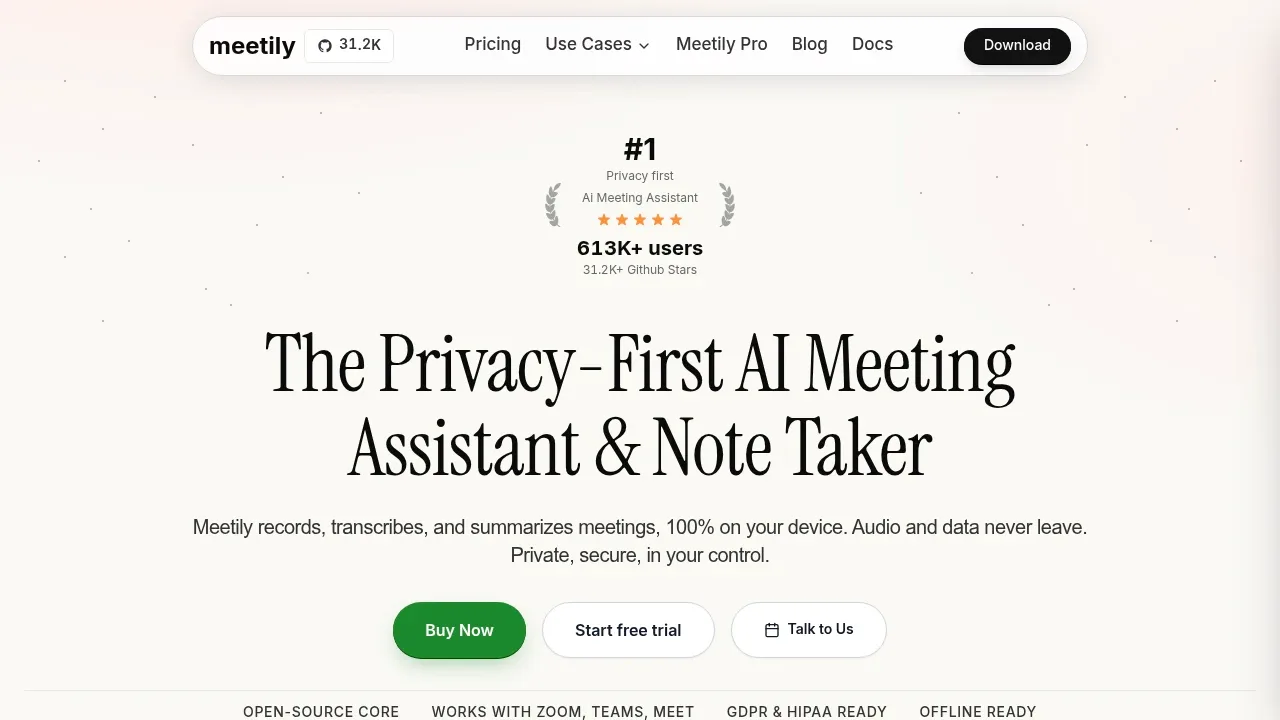
Meetily is a local AI meeting assistant for people who want meeting notes while keeping recordings on their own device. It captures calls from Zoom, Google Meet, Microsoft Teams and other meeting software without placing a bot in the meeting. You can watch the transcript appear during the call, then generate a summary.
Recording and transcription run on the computer using Whisper or Parakeet speech models. Audio and stored transcripts stay local. For summaries, Ollama can process the transcript locally. If you choose Claude, OpenAI, Groq or OpenRouter with your own API key, transcript text goes to that provider, while the audio stays on your device. It works fully offline after setup when you use local models.
Meetily can also transcribe existing audio files. It captures microphone and system audio together, so it doesn't need a browser extension or a separate integration for each meeting service. That suits people who need a record of confidential calls without adding another participant.
The Community Edition is open source under the MIT license. Desktop apps are available for macOS and Windows; Linux users can build the app from source. The macOS package uses Metal and CoreML acceleration. The Windows package uses Vulkan for Whisper and requires an AVX2-capable x64 CPU.
Claim this page with an email at meetily.zackriya.com. Meetily gets the verified badge, and you can upgrade the listing to be featured on localhosted. Proud to be listed? Put our badge on your site.
Want more people to find Meetily?Promote it
Something wrong or outdated on this page?
9.4KUpdated 1 day agoMIT
macOS · Windows · Linux · iOS · Android#LM Studio integration#MCP#Ollama integration
Anarlog, formerly Hyprnote, is a desktop AI meeting notetaker for people who want to keep private conversations on their own hardware. It captures audio from your device without adding a bot to the call and stays hidden during screen sharing. The app runs on macOS, Windows and Linux; its community application is open source under the MIT license.
21.8KUpdated 20 hours ago
macOS · Windows · Linux#MCP#Multimodal input#Ollama integration
Screenpipe records screen activity and audio as searchable local history that AI agents can use as context. It's for people who want to recall past work and teams that want agents to draft follow-ups or update work records using what actually happened. Raw history stays on your device by default.
54KUpdated 2 days agoMIT
macOS · Windows · Linux · iOS · Android · Docker#Hugging Face integration#Quantization#Streaming inference
11.2KUpdated 1 month ago
macOS · Windows · Linux · iOS · Android · Web#Multilingual#Streaming inference
8.9KUpdated 9 hours agoMIT
macOS · Windows · Linux · iOS#Batch processing#MCP#Multilingual
2.8KUpdated 2 weeks agoApache-2.0
macOS · Windows · Linux · Docker · Web#Code execution#Git integration#Human approval
whisper.cpp runs OpenAI's Whisper speech recognition models on your own hardware, with fully offline transcription once you've downloaded a model. It's for developers building speech-to-text into applications and people who want to transcribe audio locally. Audio can stay on-device rather than going to a cloud transcription service. The project is open source under the MIT license.
Moonshine is an on-device AI toolkit for developers building voice agents and applications that listen and speak. It combines speech to text, intent recognition and text to speech in one library. Voice processing stays on the device, and you don't need an account or API keys.
OpenWhispr is a free, MIT-licensed dictation and meeting transcription app for people who want voice input across their apps with control over where processing happens. It's available on macOS, Windows, Linux and iOS. Local transcription works offline and keeps audio on your device; optional cloud transcription sends audio to the selected provider, whose retention policies apply.
Vexa is a meeting bot and transcription API for developers building meeting features and teams feeding calls into AI agents. Bots join Google Meet, Microsoft Teams and Zoom, then send live transcripts with speaker labels to your application or agent. You can host the full platform on your own infrastructure or use Vexa's cloud service.