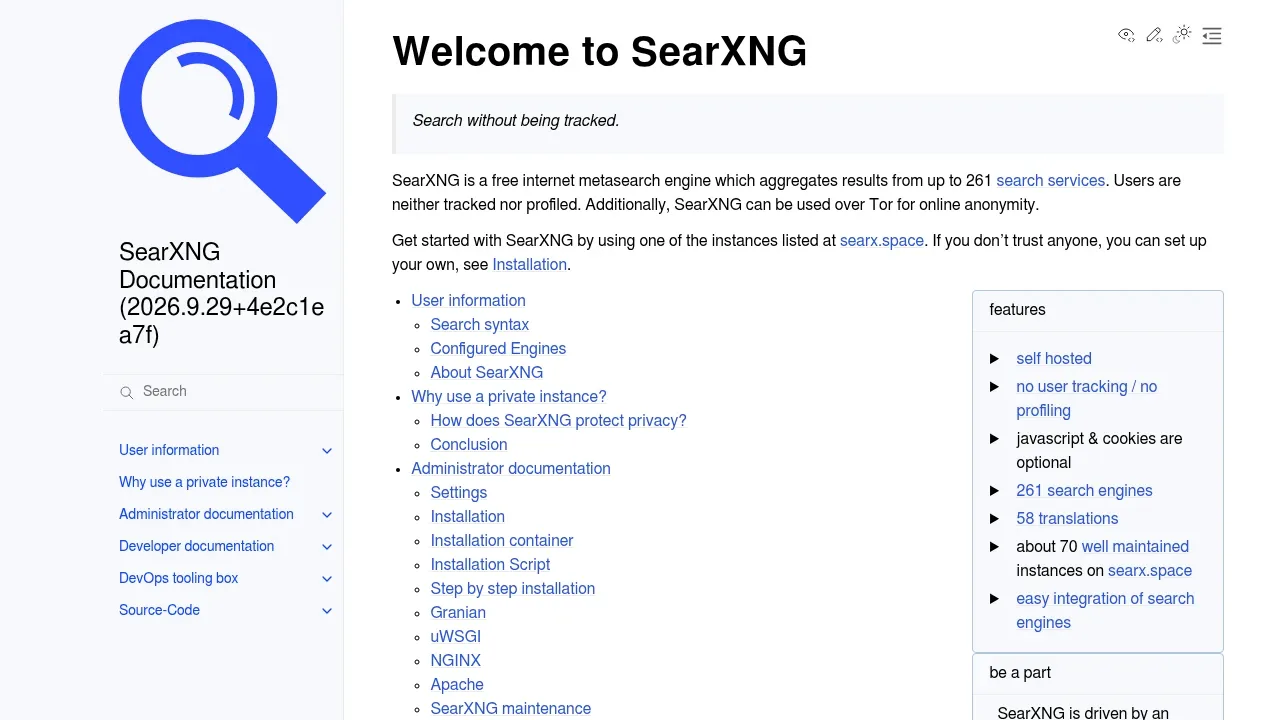
SearXNG is a self-hosted metasearch engine for people who want web search without user tracking or profiling. It brings results from separate search services into one browser interface. You can run your own instance or use a public one, depending on who you want to trust with your searches.
Web searches need internet access: the server queries external search services rather than keeping the search entirely on your machine. Hosting it yourself gives you control over the instance, but those services still supply the results. SearXNG also supports access over Tor, and JavaScript and cookies are optional in its interface.
Supported sources include Google, Bing, Brave and DuckDuckGo, alongside specialist services such as arXiv, PubMed, GitHub Code and Open Library. That makes it useful for research and technical searches as well as general browsing. It can present images, videos, papers, code and files, with search categories for different kinds of results.
A search API lets other applications use the results. For people who need to search their own information, it also has engine support for local search APIs and SQL or NoSQL databases. Plugins provide tools such as a calculator and unit conversion.
The project builds on searx as a fork. It's open source under AGPL-3.0-or-later, written in Python, and supports container deployment on a self-hosted server.
Claim this page with an email at docs.searxng.org. SearXNG gets the verified badge, and you can upgrade the listing to be featured on localhosted. Proud to be listed? Put our badge on your site.
Want more people to find SearXNG?Promote it
Something wrong or outdated on this page?
182KUpdated 16 hours agoMIT
macOS · Windows · Linux · Docker#GGUF#llama.cpp backend#Multimodal input
Ollama runs language models on your own computer or server. It provides a command-line runner and a local API for people building AI applications or connecting existing tools to models they host themselves. The software is distributed under the MIT license.
9.1KUpdated 21 hours agoMIT
macOS · Windows · Linux · Docker · Web#llama.cpp backend#MCP#Multi-user access
37.5KUpdated 2 months agoAGPL-3.0
Web#RAG#Semantic search#Web search
153.6KUpdated 1 week ago
Docker · Web#Code execution#Human approval#Hybrid search
390.8KUpdated 19 hours ago
macOS · Windows · Linux · iOS · Android · Docker#Multi-user access#Persistent memory#Tool calling
3.5KUpdated 2 years agoApache-2.0
Docker · Web#Ollama integration#Web search
Farfalle is a self-hosted AI search engine for people who want a Perplexity-style search app with a choice of local or cloud models. It combines web search with model-generated answers and includes an agent that plans and carries out searches. The code is open source under Apache 2.0.
Local Deep Research is a self-hosted AI research assistant for people who need cited answers drawn from academic papers, the web and their own documents. It can produce a quick summary or pursue a complex question through repeated searches, then assemble a structured report. It's open source under MIT.
Khoj is an AI assistant for people who want to ask questions across their own files, research the web, and give recurring work to agents. You can self-host it on your computer or server, or use Khoj's cloud app. It's open source under the GNU AGPL v3.0 license.
Open WebUI gives individuals and teams a self-hosted place to chat with local LLMs and cloud models. It runs on your own computer or server, including through Docker, and can work entirely offline with local models.
OpenClaw is a self-hosted AI assistant that connects your own computer to the messaging services you already use. It's for people who want a personal assistant on their laptop, or teams that want to run a shared assistant on their own hardware. The project is open source under the MIT license.