
Pi
A terminal coding agent that runs locally, supports Ollama and cloud models, and lets developers customize tools and workflows under the MIT license.
Alternative to:



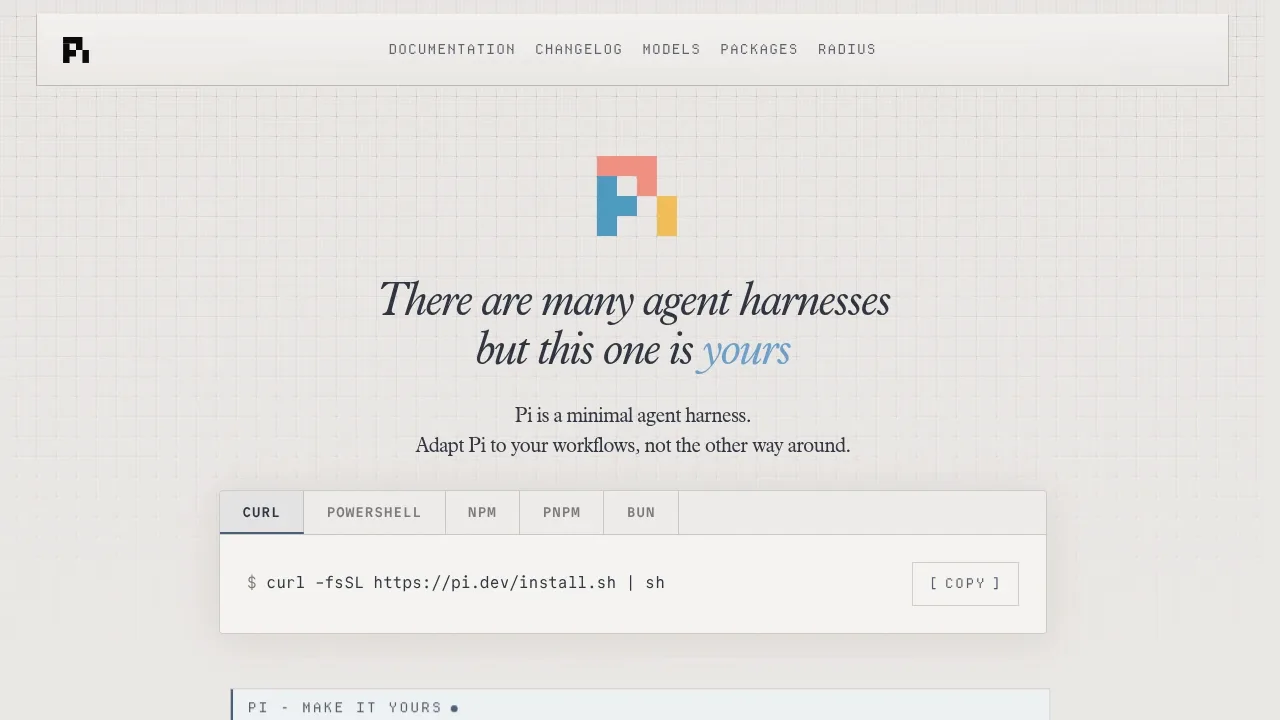
Pi is a terminal coding agent for developers who want an assistant they can adapt to their projects. Its small core supports custom workflows through extensions and shareable packages.
- Model choice: Connect to Ollama for local LLMs or cloud providers such as Anthropic, OpenAI, Google and OpenRouter, switch models during a session, and add custom providers.
- Custom workflows: Extensions can change tools, commands and the terminal interface, and Pi can write its own extensions; packages can combine extensions, skills, prompts and themes.
- Branching sessions: Return to an earlier message and try another approach while keeping other branches, then export the history as HTML or share it through a GitHub gist.
- Project context: Pi reads AGENTS.md instructions and supports custom system prompts and control over how it summarizes older messages; you can also steer an active task or queue a follow-up.
- Automation and integrations: Use interactive sessions, scripted text or JSON output, RPC or a TypeScript SDK, with built-in MCP support for external tools.
Pi runs locally on Windows, macOS and Linux, or in a local Docker container. It's open source under the MIT license. Cloud model requests go to the selected provider.
Pi has no built-in permission system. By default, it inherits the filesystem, process, network and credential access of the user and process that launched it. Integrated sub-agents and plan mode aren't built in; extensions or packages can add them, and separate Pi instances can run through tmux.
 Logotyper


