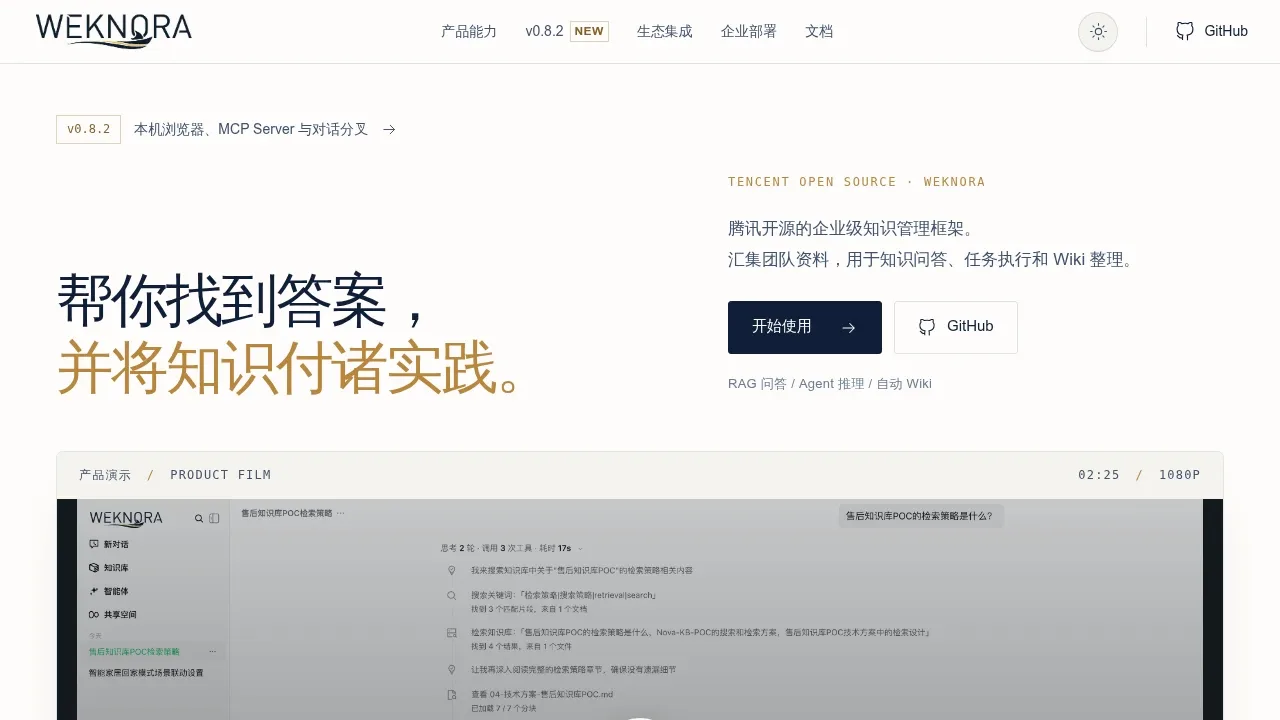
WeKnora is a self-hosted AI knowledge platform for teams that want to ask questions about their documents, use them in agent tasks and organize them into a wiki. These functions share the same knowledge base. It supports local inference through Ollama and offline deployments, with replaceable model, database and storage backends.
Document Q&A combines keyword and semantic search, then attaches source citations so readers can check answers against the original material. It accepts PDFs, Office files and images, and can sync content from Confluence, GitLab, Notion, Feishu and other services. The wiki turns documents into linked pages with citations and a knowledge graph. Teams can edit pages, compare revisions and restore earlier versions.
The agent can search the knowledge base and web, call MCP tools, run skills and create files in a sandbox. A terminal and graphical desktop let users inspect its work or take over. BrowserSkill lets it operate the user's own Chrome or Edge, handing control back for logins and CAPTCHAs. Conversations support branching and rollback, and the agent can retain preferences users have confirmed across sessions.
Teams can run WeKnora in Docker or Kubernetes, use its single-machine edition or desktop app, or deploy it on a private cloud. A separate hosted service provides knowledge Q&A for WeChat. Local deployments can keep data in the team's environment; cloud model providers are optional. Workspace permissions, OIDC and audit logs support team access, while the built-in MCP server makes knowledge bases available to Claude and Cursor.
Claim this page with an email at weknora.weixin.qq.com. WeKnora gets the verified badge, and you can upgrade the listing to be featured on localhosted. Proud to be listed? Put our badge on your site.
Want more people to find WeKnora?Promote it
Something wrong or outdated on this page?
619Updated 5 days agoMIT
Docker · Web#Agent Skills#Hybrid search#Knowledge graphs
sage-wiki turns documents into linked articles and a knowledge graph that both people and AI agents can query. It's for personal research collections, shared team knowledge, and agents that need a lasting memory of what they've learned. The software is open source under the MIT license and runs as a Go binary or in Docker on your own machine or server. It supports local models through Ollama.
247Updated 2 days agoAGPL-3.0
macOS · Windows · Linux · Docker#Hybrid search#MCP#Multimodal input
32.3KUpdated 20 hours ago
Docker · Web · Browser Extension#MCP#Multi-user access#Ollama integration
29.4KUpdated 5 days agoAGPL-3.0
iOS · Android · Docker · Web · Browser Extension#MCP#Multi-user access#Ollama integration
8.7KUpdated 19 hours agoMIT
macOS · Windows · Linux · Docker · Web#Git integration#Hybrid search#Knowledge graphs
117Updated 5 days ago
Docker · Web#Guardrails#Human approval#Hybrid search
AlexClaw is a self-hosted personal AI agent for one operator who wants to monitor information sources and automate recurring tasks on their own infrastructure. Built on Elixir/OTP and available through Docker, it collects RSS feeds, web pages, GitHub activity and API data into a searchable knowledge base. It has no multi-user access control.
Marginalia is a local-first AI research agent for people whose research papers, notes and working documents are scattered across different formats. It checks relevant passages in the original files before writing answers with citations. Your library stays in readable folders by default.
Onyx is an AI search and chat platform for teams whose information is spread across workplace apps. It indexes company knowledge so employees can ask questions across sources and get answers grounded in relevant documents. Teams can deploy it in their own cloud or on bare metal, including an air-gapped environment.
Karakeep is a bookmark manager for people who collect links, notes, images and PDFs in one place. You can run the open source app on your own server with Docker under the AGPL-3.0 license, or use the managed Karakeep Cloud service. It has a web app, iOS and Android apps, and extensions for Chrome, Firefox and Safari.
ai-memory keeps project knowledge on a server you control so developers can switch coding assistants or machines without losing context. It connects Claude Code, Codex, Cursor, Gemini CLI and OpenCode to shared memory, including unfinished work, failed approaches and open questions.